
Finding Joy Pt. 2
Five Perfect Episodes of Television

I watch too much TV.
Always have.
Ever since I can remember, television has been a constant fixture in my life.
When I was small, it delivered hokey Batman episodes, The Dukes of Hazzard, and plenty of cartoons on Saturday mornings. PBS taught me science and writing. I was held in rapt attention while the Reverend Dr. Syn fought the British press gangs in the Romney Marsh.
When I was a teen, it was where the Milwaukee Brewers played, the Green Bay Packers chased gridiron glory, and the Wisconsin Badgers battled for pucks.
It delivered me Sherlock Holmes, Hercule Poirot, and Brother Cadfael. It showed me MASH, Cheers, and Bob Newhart. I watched Magnum PI, Simon & Simon, and Hunter. I watched Friday Night Videos because I didn’t have cable, and that was the only way I could stay current on popular music. I watched Saturday Night Live, and it shaped my sense of humor and honed my understanding of what satire is.
During college, I was always in front of a TV on Monday nights. I’d watch WCW Monday Nitro on TNT, then flip over to USA to watch WWE Monday Night Raw, comparing and contrasting the programs back when professional wrestling was at its most golden era. I learned a lot about heroes and villains from those shows, and a little about storytelling. Mostly, it was mindless entertainment.
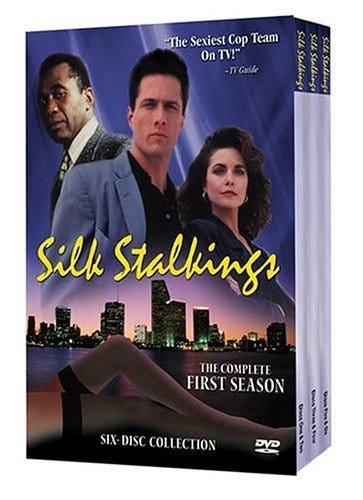
I watched a lot of meaningless melodrama, too. Silk Stalkings was a favorite in my college days—Mitzi Kapture (great name…) and Rob Estes solving sexually driven crimes of passion in the high-society of Palm Beach. Pacific Blue, La Femme Nikita, Sweating Bullets, and The Big Easy. I also loved Duckman, which was waaay ahead of its time. It was a precursor to things like Bojack Horseman and other odd animated features that walked a fine line between comedy and pathos.
Even my undergrad senior project was TV-related. I wrote, storyboarded, and set a production schedule for a pilot TV show. That pilot script idea was later brought out of cold storage, combined with the spirit of Joss Whedon’s Firefly, and became Strange Angels.1
During the last semester of my senior year at UW-Whitewater, one of my professors (rest in peace, Dr. Conover) told me how to apply for a writing job on a talk show. He told me to write a few pages of topical jokes and submit a packet of sketches. I took a couple of weeks and came up with a few pages of one-liners and some oddball sketches that I mailed to 30 Rockefeller Plaza, addressed to Conan O’Brien, in hopes of procuring a job in his writer’s room. No one ever responded to it.
Probably for good reason. Some of those sketches were out there.
Television gave me stories that made me dream. It showed me interesting and inspiring people. For a kid growing up deep in the middle of the sticks of southern Wisconsin, it was a lifeline to the outside world.
I was never an outdoors kid. I had to be chased away from the television and forced to go get some sunshine.
Even now, television is what keeps me going a lot of the time. On Sundays, I look forward to episodes of Tracker and Watson. Tuesdays are when Will Trent solves murders for the Georgia Bureau of Investigation.
Despite streaming providing easy access to just about anything the day after it airs, I still try to catch a lot of shows in the “old” way—by sitting in front of the TV when it airs in real-time, just like I had to as a kid.
I remember one of the worst feelings in the age of VCRs was getting home from a school event to watch something we taped at 7:00 pm, only to find out that the VCR had cut off the final minute of the show. Or, when we were actually home and ready to watch something good, some tragedy happened, and Tom Brokaw would jump onto the set with his serious face, and there goes the whole night.
My undergrad degree was in sports journalism. If I had to do it all over again, I think I would have focused on screenwriting, moved to California after graduation, and really given writing and/or performing a go. I have wanted to be involved in television for my whole life, just to be a part of that big storytelling machine.
TV is a source of comfort and entertainment.
So, for this installment of Finding Joy, I’d like to present a few perfect episodes of television.
19-2, “School,” S02E01
If you’re not familiar with 19-2, it is my favorite cop drama of all-time. Only forty episodes over four seasons, but it delivered with each and every episode.
Set in Montreal, Quebec, 19-2 was the daily goings-on of a police precinct and the tortured and conflicted lives of the officers who worked there. The cast was led by Adrian Holmes and Jared Keeso (who would later rocket to larger fame in Letterkenny and Shoresy), who played unwilling partners. In 2015, Keeso would win a Gemini Award for Best Performance by an Actor in a Continuing Leading Dramatic Role, and in 2017, Holmes would pick one for himself, as well. The show was a critical success.
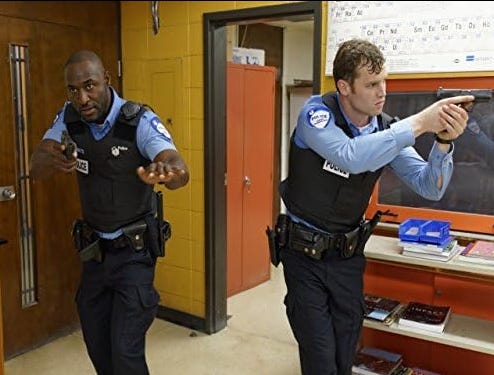
Every episode of 19-2 is great, but one stands out above all others. In the first episode of Season 2, the Station responds to an active shooter at a local high school. When they arrive, they find bodies and hear shots being fired, and the entire episode is a tense, sweaty, and claustrophobic search for the gunman.
It is, hands down, the single best episode of television I have ever watched.
The situation is riveting, especially if you have invested yourself in caring about the characters over the course of the first season. The direction, the editing, the performances—all perfect. The director, Daniel Grou2, who uses the name “Podz,” won the 2016 Gemini Award for directing that episode, and the show itself took the 2016 Gemini for Best Dramatic Series that year, largely due to this episode.
Given the nature of the show, it’s not for the faint of heart. It’s gritty. It doesn’t hold back. Seeing wounded children in the hallways does something to a person, and if you’re not mentally prepared for it, this is an episode that can wreck you. I don’t blame you if you avoid it.
However, it’s rare to find an hour of television that delivers as much as “School” does.
10/10. No notes.
It should be noted that school shootings are not exclusive to America. Long before Columbine in 1999, way back in 1975, Michael Slobodian, a 16-year-old student at Brampton Centennial Secondary School in Brampton, Ontario, left a note for his parents stating, "I am going to eliminate certain people from this world. Those people are: Mrs. Wright, Mr. Bronson, and any other sucker who gets in my way. I am then going to kill myself so as not to be imprisoned."
Slobodian then went to Brampton Centennial with two rifles in a guitar case and 70 rounds of ammunition. He prepared the weapons in a restroom. He then shot seven rounds, killing student John Slinger and wounding another with a .22-calibre Ruger semi-automatic rifle.
Slobodian switched to a Marlin .44 and fired into a classroom, wounding two more students. He shot indiscriminately down two hallways, wounding four students with shrapnel down one, and another student down the other. He proceeded to an art classroom, killed English teacher Margaret Wright (who was six months pregnant at the time), shooting her in the back as she tried to flee, and wounded two more students.
Slobodian then returned to the hallway, put the rifle barrel to his chin, and ended his rampage. Three dead (including Slobodian). Thirteen wounded.
One of the witnesses to the attack was a future member of The Kids in the Hall, Scott Thompson. Thompson had been one of Slobodian’s classmates in Mrs. Wright’s English class.
Firefly, “Out of Gas,” S01E08
While I could probably have made a case for just about any of the episodes of the tragically short single-season of Firefly, “Out of Gas” stands out above the others.
The show differs stylistically from the other episodes of the series, taking place in the past and the present, with vignettes to the distant past, showing how the crew of the intrepid ship Serenity came to find each other, the odd little dysfunctional space family that they are. In the pilot episode, Captain Malcolm Reynolds, first officer Zoe Allyne-Washburne, pilot Hoban “Wash” Washburne, passenger Inara Serra, mercenary Jayne Cobb, and ship’s mechanic Kaylee Frye were already onboard the ship. In the pilot, we got to see how Doctor Simon Tam and his sister, River, joined the ship’s crew, and we saw how the wandering Shepherd Derrial Book joined…but everyone else was just a crew until “Out of Gas” showed us how they came together.
Written by the great Tim Minear, “Out of Gas” is a lesson in storytelling. It starts by giving us the stakes: the ship Serenity is adrift and silent. Cut to the interior. Captain Malcolm Reynolds is lying on the floor of the cargo bay, face down, struggling, weakened, sweaty. Something is wrong.
Someone’s voice, a ghost of the past, says, “A real beauty, ain’t she? I tell you what—you buy this ship, treat her properly, and she’ll be with you the rest of your life.”
From there, we cut to the distant past. Reynolds brings his second-in-command on board Serenity for the first time. Zoe is unimpressed. He tells her about his vision of the good life, outrunning the Alliance and taking jobs as they come. Living “like real people.”
He even tells her he’s got a name all picked out.
From there, Minear guides us back-and-forth through time in the narrative. We learn that Serenity has suffered a catastrophic engine failure, and no magic in the ‘Verse can get her running again. They are adrift, and heat and oxygen are running low.
We learn how the crew members came together as we jump into Reynolds’s memories as he struggles to get the ship running again after the rest of them departed on shuttles, a fool’s errand to find help because at least the shuttles have heat and oxygen.
We get the happy ending we deserve, and in the final moments, we cut back to the opening lines: “A real beauty, ain’t she? I tell you what—you buy this ship, treat her properly, and she’ll be with you the rest of your life.”
Reynolds is at a shipyard, and a salesman is showing him an impressive vessel, tall and mighty—but it ain’t Serenity.
Reynolds doesn’t hear him. He’s not looking at the ship he’s being shown. He’s looking into the distance, a curious expression on his face, longing in his eyes. He is staring at a piece of rusted scrap on the sand at the edge of the shipyard, a distinctive-looking Firefly-class vessel with its horsehead prow and bulbous rear engine.
It’s Serenity.
And you realize the whole episode is a love story—the love of a man and his ship, and the love the crew feels for each other. It’s the tale of a broken man finding a broken ship, and making her whole again.
It never fails to choke me up.
Firefly never should have been cancelled.
MASH, “Welcome to Korea, Pts. 1 & 2,” S04E01 & S04E02
Season four was a big shakeup for MASH. It was on the verge of being the ratings juggernaut that we all know it to be now (forgetting that it struggled a bit out of the gates), and the show had just lost two of its biggest stars as MacLean Stevenson bowed out as Lt. Colonel Henry Blake to star in a sitcom that failed3, and Wayne Rogers left to become a money-marketing genius4.
However, MASH would continue to find success, running for another eight seasons, and the first two episodes of Season Four showed that the showrunners knew what they were doing. They replaced Trapper John with the affable BJ Hunnicutt (Mike Farrell), and brought on Harry Morgan to fill the CO’s spot with the wonderful character of Colonel Sherman T. Potter.
In “Welcome to Korea,” Hawkeye returned from R&R to find that his best friend, Trapper John, had received orders while Hawk was in Japan resting and recreating, and had departed the Four-Oh-Double-Natural for Kenpo Airbase in Seoul. Hawkeye runs to say his goodbyes, but just barely misses Trapper.
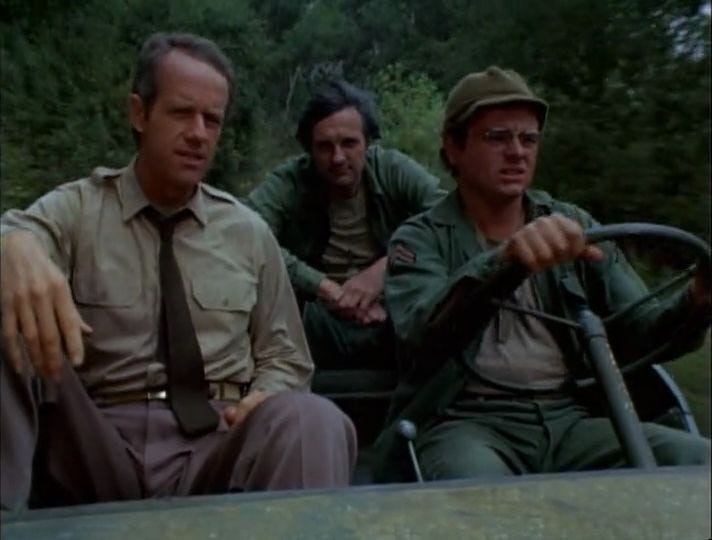
Instead, he and Radar bring back 4077’s new surgeon, Hunnicutt. There is a gentle feeling-out of personalities as Hunnicutt deals with Hawkeye’s mood swings over missing Trapper, and eventually, they return to camp. They run across a platoon and are ambushed alongside them, being Johnny-on-the-spot for treating the wounded. Poor BJ gets his first taste of combat medicience, and it’s not pretty. They stop at Rosie’s bar to solidify their friendship over too much beer and sake. This ruins Frank Burns’s plans to mold Hunnicutt in his own image, and we know that BJ is going to be on Hawkeye’s side when he gets out of the jeep, salutes, and drunkenly slurs, “What say you, Ferret-face?”
The episode ends with the arrival of Col. Potter, and we’re left to wonder if the new CO is going to be a good guy or not. We learn more about him in the next episode, “Change of Command.”
This episode strikes the tone of comedy and drama that MASH did so well, showing the horrors of war and then giving us a reason to laugh. It was written by the power trio of Everett Greenbaum, Jim Fritzell, and Larry Gelbart. Gelbart was called a “Mozart of Sitcoms.”
Those guys made a lot of television in the ‘70s and ‘80s.
Scrubs, “My Philosophy,” S02E13
I could have pulled any number of Scrubs episodes. Not only is it one of the best sitcoms of all time, but it also has a ton of amazing episodes. Most critics and fans point to “My Screw-Up” (S03E14), in which Brendan Fraser returns as Ben Sullivan and dies of leukemia. Dr. Cox (John C. McGinley) is stellar as he blames JD for this and overcompensates, while being haunted by Ben’s ghost until they hit the finale and Cox is forced to confront the death of his best friend, brought to reality by JD’s haunting line, “Where do you think we are?” and the reveal of the cemetery and Ben’s funeral. It’s considered one of the best episodes of television ever and has received all the laurels and accolades it needs.
So, why beat a dead horse? Scrubs has a ton of great episodes that will make you laugh and cry in the same 22 minutes, and not many shows have done it as well or as poignantly.
In “My Philosophy,” which landed as a mid-season finale in season two, most of the beloved members of Sacred Heart are at an impasse, giving us high stakes to dwell upon over the long holiday break.
There are several storylines running through the episode:
Chris Turk has bought a ring and is ready to propose to Carla, but the young patient Ralphie swallows it, so Turk makes Ralphie eat six bran muffins in order to retrieve it.
Elliot and Ted conspire to get the women of Sacred Heart a women’s locker room instead of the co-ed dressing room they’ve used for years—and this requires Elliot to stand up to Doctor Kelso.
Cox and JD have a pregnant patient with heart issues, and when she crashes, her husband has to make a decision over a delicate procedure to save his wife, which puts the baby’s life at risk, knowing that his wife asked him to save the baby regardless of anything else.
One of JD’s favorite patients, Elaine, is back in the hospital, still waiting on a heart transplant. They have a frank discussion about death, and Elaine says she hopes it’s like a Broadway musical, with costumes and singing.
As the show progresses, all these storylines boil over:
Turk proposes to Carla, but she can’t give him an answer because of issues with her family, leaving him in a confused, heartbroken limbo.
Elliot and Ted get the locker room.
The pregnant patient survives the procedure that could have killed her, and they are able to save both her and the baby.
Elaine crashes and cannot be revived. In JD’s imagination, we see her go out singing Colin Hay’s powerful song “Waiting for My Real Life” to begin while being joined by the cast, Broadway-style. When they pronounce her dead, Cox asks JD if he’s okay, and JD can only whisper, “Yeah.”
Because life and death are just part of the cycle of the hospital.
For a mid-season finale, it makes your heart swell. It’s a tear-jerker, and it gives most of the characters real stakes in their lives. Just a magnificent episode in a series that has more magnificent episodes than just about every series ever written.
Happy Endings, “Dave of the Dead,” S01E07
Happy Endings is a show that doesn’t get nearly enough credit. While being in the same vein of the “Pretty People Just Hanging Out” variety that we’ve seen in Friends, The New Girl, How I Met Your Mother, Rules of Engagement, and dozens more failed attempts of shows just like Friends, it was far more wacky than the rest of them, driven predominantly by Casey Wilson’s larger-than-life, over-the-top character Penny Hartz.
While the whole cast is excessive in personality, Penny is clearly the top dog of this pile of crazy.5
My favorite Penny moment is in the first episode when she’s sweating on a machine in the gym, and a tiny, little waif with a perfect stomach and petite body comes over and asks, “Ma’am, are you done with this machine?”
Penny, in her extremes, is horrified. She climbs off the machine and says, “Ma’am? I’m going to go bawl my eyes out, and then I will be back to physically fight you.”
In “Dave of the Dead,” we are given the traditional three-storyline plot that Happy Endings was famous for. In each episode of the series, the six members of the core group are usually split into 2-2-2, 3-2-1, or 3-3 groups, and they navigate two or three separate storylines that somehow converge in the third act. It’s great writing.
In this episode:
Penny is dating a hipster and trying to keep up with him and his group of friends, and their need for excessive irony in all things is killing her.
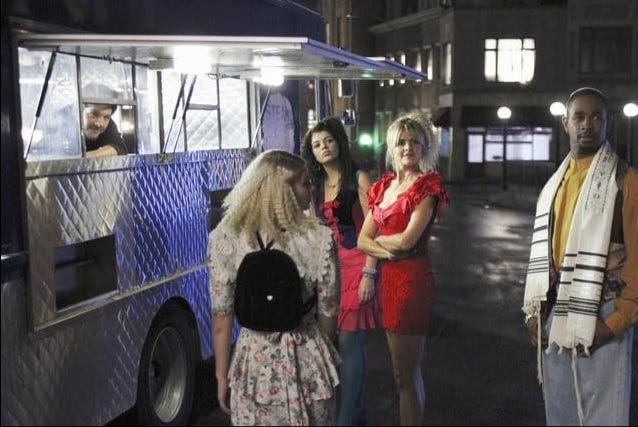
Dave wants to quit his office job and start his restaurant, so he buys a food truck.
Max and Jane compete in a series of challenges to see who would best survive a zombie apocalypse.
The episode's main focus is on Penny and the hipsters. Like most hipsters, they are exhausting. Penny, who unironically truly does like things like ABBA, musicals, and cute sweatshirts with kitties on them, is having trouble keeping up with their negativity and thrift-store clothes.
Dave is trying to get his restaurant off the ground, and, given that he has no money, has to do it with a food truck, which he is initially embarrassed about and tries to hide from the rest of them.
Max and Jane are busy with their antics about the zombie apocalypse.
In the end, the three stories magically converge after Penny has erupted at the hipsters and needs to flee. The hipsters chase the group, not unlike a horde of zombies, and they all escape on Dave’s food truck to live another day.
If this sounds bizarre, it is.
It’s also why Happy Endings was highly underrated and never got the fan support it deserved.
There you go: Five perfect episodes of television. Great in all aspects. If any of this gives you something new to watch—enjoy.
Can you tell that I’m procrastinating on the current work-in-progress, by the way?
It’s true what they say about writers and procrastination—we’ll do anything to keep from actually having to work on the new book.
Hopefully more about that thing in the near future.
Also, I know I’m old because I bought a new pocket knife, and that’s kind of exciting for me. It’s not quite as small or as thin as I would have liked, but I’ll adapt.

If you have an episode of a television program that you believe to be perfect in all aspects—acting, writing, direction, etc… Please let me know about it in the comments. I’m always up for good TV.
Until next time, true believers.
A book I still love…but man, it’s just not finding an audience. If you know any Firefly fans, let ‘em know it exists, will you?
19-2 was originally a three-season, French-language drama in Quebec, written and directed by Podz in 2011. It was redone in English in 2015.
Stevenson would later say that leaving MASH was his biggest regret.
Rogers was a whiz at the stock market. The rest of the cast of the show turned to him for investment advice, and he made all of them far wealthier than even the heady paychecks of 1970s sitcoms and residual checks would have.
Happy Endings also doesn’t get enough credit for being the only show with a gay character who wasn’t an over-the-top caricature of gay men. Adam Pally’s Max Blum is basically the gay version of The Odd Couple’s Oscar Madison. He’s slovenly, a slob who doesn’t care about fashion. He likes sports. He hates musicals and stereotypical gay things. He’s not effeminate. He’s not like Jack in Will and Grace. He doesn’t even really talk about being gay all that much. Being gay was just his sexuality, not the focal point of his personality.
I remember watching MASH (mostly in re-runs I think) and having no clue it was about an actual war we were in.
Did you ever watch Battlestar Galactica? The newer one. The last episode of that is possibly my favorite episode of tv ever.
"Happy Endings" was incredible! I never understood why it wasn't a bigger hit.