
Success? Never Met Her...
The Sliding Definition of Achievement

Success is the slipperiest of fish. One moment it’s there—flashing silver and scaly just under a clear patch of stream, and the next…who the hell knows? There’s a cloud of mud and murk, and you’re pulling weeds off your hook.
I’ve long been fascinated by the idea of success because it has no concrete definition. Success is abstract by nature, and it lives on a broad, wide, sliding scale that differs from person to person and era to era.
What we define as “routine” or “average” nowadays would most certainly qualify as success to someone from 1902. What someone from 1902 believed was average would have blown the mind of someone in Europe in 1245 AD.

My current idea of success would make Taylor Swift break down, cry, vomit, and quit music because she couldn’t afford the pay cut or lack of adulation.
I have always known I wanted to write books, but I never really thought about what success as a writer meant until I was in college. I had a writing professor at Winona State (Go Warriors) who asked us, “What do you want to do as a writer?”
What the heck did that even mean? I had no clue. I had never considered the question. I wanted to write. I wanted to write books.
None of us in the class had the bravado or audacity to raise our hands and proclaim, “I want to be a rich and famous writer.” If I recall, none of us in the cohort even answered. We looked at each other stupidly for a few moments, and then the prof said, “Anyone?”
So, me being the big doofus I am, I raised my hand and said, “I’d like to make a living as a writer.”
The prof said, “What does that entail?”
I shrugged and said, “Bills paid. A house in the ‘burbs. Maybe two cars? I don’t know.”
To his credit, this professor said, “That ain’t gonna happen.”
He was a realist.
He didn’t sugarcoat things.
This was the first time someone made me think about what success as a writer would even look like. I hadn’t thought about it before that moment. I was pragmatic enough to think I’d never be Stephen J. Cannell, Stephen King, or Michael Crichton…but I was also stupid enough to think maybe I could get something.
At that age—I think I was 23 or 24 when I took that class—I had a picture of success in my head. It involved a house, a car, and health insurance.1 Since that class, my scale of success has had to adjust accordingly as my age and range of knowledge and experience have progressed.
Now, I’m wise enough to have a minimalist definition of success.
And I’m also wise enough to know I haven’t achieved my own, very small, very realistic definition of success. This is probably because my own insecurities and inferiority complex keep pushing what I believe to be “success” further down the sliding scale.
When I first published, just having a book available for people to purchase made me feel successful. At least for a few minutes. It gave me a sense of accomplishment. There was a physical trophy for my efforts. I made a thing.
After a while, just having that trophy wasn’t good enough. Now, I look back on that first book I made, and I loathe it. It wasn’t good enough. My standards rose. I learned more about the industry. I learned more about myself. I developed my own true voice, whereas in that first book I was just really trying hard to be Neil Gaiman.2
I needed another trophy. A better trophy. And I needed sales. And reviews.
I eventually made more trophies. Better trophies. And I got some sales. And I got some reviews. I remember when After Everyone Died broke the 50-review barrier; I was pretty amazed. And then it got to 100 reviews, and I thought I was finally a success.
And then it got to 500 reviews, and I knew it wasn’t enough. I wanted more. And the sales weren’t enough. I needed more.
I’ve now sold more copies of The Survivor Journals trilogy than most nobody authors will sell of all their books over the entire lifespan of their books…and it’s still not enough.
Success is slippery. It goes away so fast…
The other thing about success is that there are no hard-and-fast rules about it. Everyone’s definition will be different. And most of us will never know if we get there or not. How do you even know if you’re successful or not?
One of the reasons I know I’m not entirely successful: I don’t get asked to do things too often.
I look at some people, and they’re going to this conference to speak, or that conference to lead a panel, or they’re going to this festival or that festival. Or maybe they’re an artist-in-residence for a week. Or they’re on podcasts. Or they’re going to awards ceremonies. Or they’re writing articles for publications or industry newsletters.
I’m not doing any of that.
I’m at home killing time before I have to go to work, cracking forth on a new work-in-progress, and hovering in that terrible limbo between sending out query letters and waiting for the inevitable rejections from agents who are seeking anything but the stuff I’m putting out into the world.
If I’m not at the job I work to pay the bills (because my writing is paying for about a Big Mac Value Meal per month3), then I’m in front of the computer either working on a new WIP, trying to get the stuff together to publish a new WIP (a once a year thing, to be fair…), or I’m writing promotional stuff like this Substack post. And if I’m not doing any of that, I’m reading or watching TV. Sometimes, I might go out for Mexican food. (Gloria’s in Sun Prairie—try the Burrito Loco with chorizo. Thank me later.)
That’s about it.
I’m honestly one of the most boring human beings you’ll ever meet.
I’ve been asked to do a couple of podcasts. I was once asked to be interviewed for someone else’s blog post. On rare occasions, a library might have me in to teach a writing class or self-publishing class, but it’s been a while since I’ve done that. I think the last one I did, people were still masking because it was freshly post-COVID.
The point is, I’m home a lot.
Now, some people would say that I have to put myself out there to land those kinds of events—but I’d argue that I am already out there. I’m not hiding. If you Google my name, I’m the first thing that pops up.
This is actually a major victory because, for the longest time, if you Googled me, Sean Patrick Flannery would show up before me.
Damn you, Flannery!
My pal Dana Storino is a firm believer in the power of social media marketing, and she spends a considerable amount of time making great videos to share her books and personality with the public. She is adamant that I should be doing the same.
 Tiktok failed to load.
Enable 3rd party cookies or use another browser
I’m hesitant to bother doing it because no one needs my bald, Shrek-looking head filling up their social media, and social media is already full of people doing the exact same thing. To me, it feels no different than publishing or podcasting. It’s all people screaming into the void. Do I really need to add my voice to the cacophony? Or should I just say what I need to say on the page?
Dana’s really good at the social media stuff, though. I’m pretty sure if I tried to make videos, it’d mostly be close-ups of my big, potato-looking head staring blankly into the camera, then muttering, “Uh…buy my book, hey?” before fumbling for the switch to stop recording.
No one needs that.
It’s just too hard to get known as a writer in this day and age. It was never easy, but it’s even harder now. There are too many books, too many writers, and not enough bandwidth in the galaxy for everyone to achieve the levels of success they would all like to achieve, so some of us have to fall on swords and just be content with the meager drippings that we can lap up in the wake of the success of others.
With the advent of the blasphemy of AI profit-seekers, they have TRIPLED the number of books published daily. Two-thirds of all books hitting the market on any given day are AI “authors”—and I use that term loosely and with great contempt.4
And by authors, I mean scammers from China or India or some other country who are using AI to churn out vomitous scripts and publish them on Amazon, hoping that suckers will buy them.5
I saw one fake author today who has published 507 novels THIS YEAR ALONE.
It’s so bad that my next book will bear this insignia that I created on the indicia page:

As I have recently hit my 20th year in struggling in the choppy sea of the indie publishing world, I’d like to think I’ve gotten better at it. I’ve definitely learned a lot over two decades. I’ve met some people, made some inroads, but still haven’t gotten to where I want to be.
I like to think my sliding scale of success has gotten a little more achievable, but we all know that’s not true.
Success will forever be just beyond my grasp, always unattainable.
I could sell as many books as Michael Connelly, have my characters in hit shows like Bosch and Ballard, and I’d probably still be looking at Stephen King and thinking, There’s the definition of success—that guy over there.
Film Suggestion of the Day
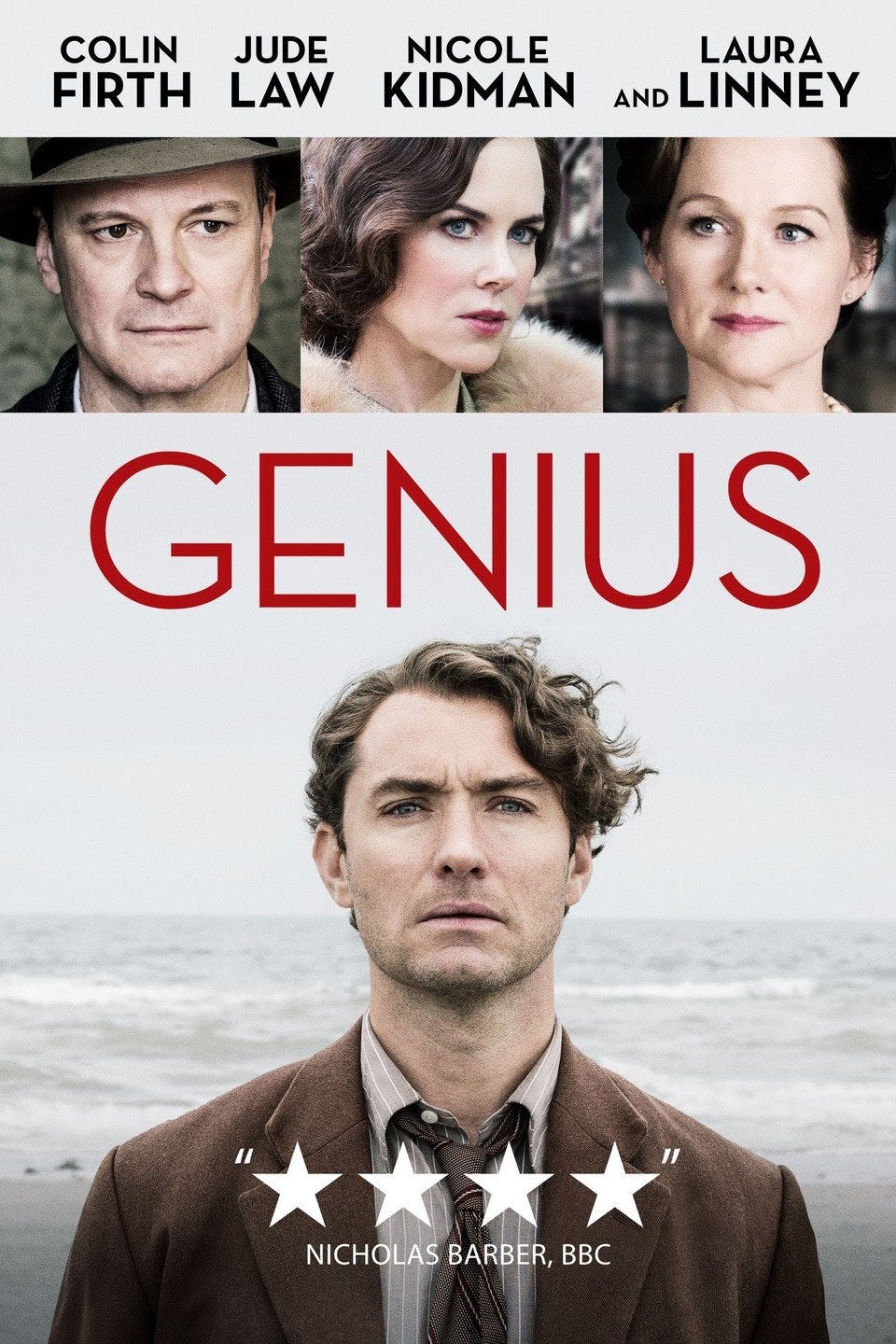
A slow-burning, but well-acted film about the great editor, Max Perkins (who worked at Scribner’s and discovered Hemingway and F. Scott Fitzgerald), and his friendship with the troubled Thomas Wolfe as they work to publish his first book, Look Homeward, Angel, and the sequel, Of Time and the River.
I’ve probably watched this movie a half-dozen times now. Just watched it again last night after work.
Colin Firth is solid as a brick in everything he does (even his sketchy singing in Mama Mia), and Jude Law’s kinetic, fractured performance as Wolfe is riveting.
This is streaming for free on Tubi right now. (Click the hyperlink above to start watching.)
That’s enough of my rambling for this installment.
Tell me your definition of success, and how you will know when you get there.
Thanks for reading.
I don’t even believe this is a realistic definition of success for an average American, let alone a writer.
Before all his allegations, of course…
I like to tell people I have a job to support my writing habit.
Bezos really needs to crack down on AI books.
Please make sure there’s an actual real human being behind the books you’re buying.
Comparison is the thief of joy my friend.
Seems to me you are living the life of your choosing. That’s a success in my book.
Everything you say about the publishing industry is true. I follow an extraordinary gifted videographer on YouTube. I don’t want to name them because I don’t believe in badmouthing creativity. They are about to publish their second book, in two years. Although their videos are world class, when I read the first book recently, I immediately needed to drink more water. How can a book about adventure be SO dry. How could a book like this get published? Two and a half million subscribers on YouTube is how. I don’t think that is in any way fair or correct. You though, are an extremely talented writer that just needs that one break for everyone to see your genius.